Category Archives: Business

Create the Need

John Patterson, known as the father of American salesmanship, is responsible for many of the modern sales practices used today. His work with the National Cash Register Company (NCR) changed the way salespeople think about marketing and selling their products.
In his book entitled The Patterson Principles of Selling, modern sales expert Jeffrey Gitomer unpacks some of Patterson’s most powerful tactics.
Patterson’s greatest sales accomplishment didn’t lie in selling cash registers, but in creating a demand for his product. He knew that sparking a desire would increase demand, and he focused his sales and marketing efforts on convincing consumers of the importance of obtaining a sales receipt. When consumers began to ask for a receipt from store clerks, the store managers felt obligated to purchase a cash register that would produce such receipts, and Patterson was poised to sell them one of his machines.
The same can be done in your business. Gitomer says in his book, “You must create a balance between the emotion to trigger the sale, and the logic to justify the purchase.” What is one thing your company could do to create a demand for your products or services?
Find Prospects Not Suspects

Are you wasting your time, money, and enthusiasm on people who sincerely aren’t interested in what you have to offer?
Instead of looking for suspects who may have the capacity to buy your product or service some day down the road, start seeking prospects who are qualified to do so today. In other words, go where the money is.
Here are some tips on how to find prime, qualified targets today:
  • Build a strong client list of names, addresses, e-mails, and phone numbers by placing customers on a preferred client mailing and announcement list. After requesting to add them to your client list, be sure to follow through and make formal announcements once you compile your client list.
  • Use the Internet to search for other industries that have a similar target audience (those who are complementary versus competitive with your business). When you determine which other businesses would also sell to your client, contact them and offer to share or trade prospect names with them.
  • Don’t limit your prospecting simply to previous or current customers. A large number of high-quality prospects and leads can be turned into profitable clients through regular and strategic communication with them.
  • Avoid general advertisements, letters, or promotions. Always make sure that your offers refer to a specific product or service. This way, readers with strong interests can easily qualify themselves and take advantage of your offer.
  • Always focus your efforts on the markets, prospects, and activities that offer you the highest probability of a payoff. The less energy you waste on suspects, the more you have left for big, rewarding prospects.

Focus on the Buy

Some marketing experts recommend that in creating a direct mail program, you should devote half your time to creating the reply form. Most clients are surprised, if not shocked, when they hear this very revealing rule. The rule is revealing because it suggests that most marketers spend too much effort on the sale and too little on the “buy.”
Think how often you have been virtually sold on something, but chose not to make the purchase because it was too hard to buy. The salesperson offered all sorts of options, for example, or made you worry about the value of an extended warranty. Perhaps they offered more complicated financing packages than you could intelligently choose among. The product was too hard to buy. Now, think of your opposite experiences. Something appealed to you a little, not necessarily a lot and the ease with which you could order, pay for, and receive the product ultimately led you to make the purchase.
Good marketing must focus on the buy. How clear is your offer? Can the prospects sample the service, thereby reducing their risk? How clear is the price? How easy is it to buy?
Save your customers some hassle and make your product easy to buy.

10 Ways to Create the Wrong Brochure

To be successful, a brochure needs to be produced with a precise objective and a target reader in mind. It’s best to create the least elaborate brochure likely to achieve its objectives.
Deciding on Your Purpose
Brochures fall into two broad categories — those that introduce a new product or service to a likely customer and those that turn an already interested customer into a buyer.
Using Color
Full color is more costly but is justified if the product or service you are offering needs color to show its features. For example, a wallpaper brochure or a brochure of knitwear would not work effectively in anything other than full color. Another reason for using full color may be to compete head-on with a rival’s color brochure.
Using two or even three colors is a cheaper alternative to full color and can be quite effective, especially if part of the brochure is printed in a screened color that lightens the tone and gives the effect of another color.
A limited use of color can look more sophisticated than bold colors. You might also consider using full color in only part of a brochure, or you might try using colored paper — although that is quite tricky to do well.
10 Ways to Create the Wrong Brochure
  1. Being concerned with the looks, but forgetting the sales objective.
  2. Giving the printer poor artwork, but expecting excellent results.
  3. Forgetting to emphasize the unique selling proposition of your business.
  4. Omitting (or hiding) prices if they are critical to the reader’s decision-making.
  5. Printing too many brochures with details that date too quickly.
  6. Giving insufficient thought to how the brochure should best be distributed.
  7. Using text on the brochure that is too small to read easily.
  8. Including poor-quality or inappropriate illustrations.
  9. Allowing a fussy or complex design to distract from the key selling message.
  10. Forgetting to monitor the response (as with any other type of advertising).

Design Direct Mail That Sells

If it sells, it is creative. This, in essence, is the first rule of direct mail design, according to legendary designer and author, David Ogilvy. But what sells?
Here are a few tips to keep in mind when designing your next direct mail marketing piece:
The basics are in your mailbox.
When you need inspiration, just go to your own personal direct mail idea vault… your mailbox! You probably receive tons of good direct mail each year. Set aside packages that catch your eye. The companies mailing these have spent thousands of dollars researching the best methods. Why not learn from their research?
Always try to beat your previous response rate.
Play around with the design before sending the mailing out again. See if minor changes make a significant difference in the response rate.
Send out different versions of your design to similar groups in your database, and test to see which one results in the most responses. Whatever you do, test it, and then test it again!
Use words that grab the reader’s attention.
Here is a recent list of “Words that Grab Attention,” produced by Starch INRA Hooper Research Worldwide:
Announcing / Discover / Easy / Exclusive / Free / Guarantee / Health / Help / Immediately / Introducing / Know / Learn / Love / Money / New / Now / Powerful / Profits / Protect / Proven / Results / Safe / Save / Secret(s) / Today / Trust / Understand / You
As you design the mailer, remember… have fun!

http://www.ParagonPress.net / Over 34 years, #1 in Shreveport, LA for print, design, mail.

4 Keys to More Meaningful Customer Relations


Companies lose an average of 10 to 30% of their customers each year. Much of this loss can be attributed to poor service. Companies that focus on customer retention tend to see profits grow anywhere from 25 to 100% annually. Nonprofits that focus on customer retention often see reductions in turnover and better results. In business, we all strive to provide outstanding customer service. Unfortunately, we don’t always live up to those ideals. Here are four keys to unlocking richer, more meaningful relationships with your customers:

Learn your customers’ names. Everybody appreciates being recognized when they walk into a place of business, particularly if they visit that company frequently. As the theme song to Cheers puts it, “Sometimes, you want to go where everybody knows your name.” Make a concerted effort to learn the names of the people you come into contact with regularly, and greet them by name whenever possible.
But start with last names first. Of course, before you start addressing customers on a first-name basis, make sure they’re comfortable with this practice. Some customers might find it disrespectful or “too” personal to have you greet them by their first name. Follow the customer’s lead, if possible, or try starting with “Mr. Johnson,” before calling your customer “Bob,” particularly if they are not your peer.
Show genuine appreciation. Let your customers know you’re glad to see them every time they walk through the door. Make an effort to greet people with a warm smile and an enthusiastic hello. Then back it up with outstanding service and a “can do” attitude. Thank your customers when they buy from you, and keep in touch to let them know they’re on your mind… and appreciated for everything they do.
Avoid judgments and negativity. We’ve all heard the adage, “You can’t judge a book by its cover.” The same is true of people. Strive to approach each new or prospective customer with an open mind and positive attitude. Don’t rush to judgment based on a first impression. Many times, those initial reactions and snap judgments don’t hold up to the test of time.

http://www.ParagonPress.net

From Profile Cards to Luggage Tags

Paragon Press Shreveport is offering to print 250 free “profile cards” (they’re like business cards but a little smaller) to anyone. Anyone as in open to the public. The free cards can be redeemed at www.ParagonPressFreeProfileCards.com. What’s the catch? Just follow us on Twitter or become a fan at Facebook.

On the redemption website, let us know who you are, what kind of design you want, and what you want printed on the cards. So I just noticed someone only put their name. Now, at first I thought this person has totally missed the point, but then it occurred to me that I’m the one who has totally missed the point! I’ve been thinking these things have to be used in business card fashion, but they don’t. Try:

  • Luggage tags
  • Property Of: Name
  • Tags for Art Shows
  • This belongs to: Your Name
  • Mini-bookmarks
  • Carefully prepared by: Your Name
  • Compliments of: Your Name

What else could you use these for?

mail@paragonpress.net / www.ParagonPress.net / Over 34 years, #1 in Shreveport, LA for PRINT, DESIGN, MAIL.

Advertising & promoting actually does work!

Every year in Shreveport, LA, the Mardi Gras season (Feb) is celebrated with lots of parades – the biggest of them being the Krewe of Centaur and Krewe of Gemini parades. These 2 parades have a long route through Shreveport and attracts thousands of parade visitors.

A few of our employees are members of these 2 krewes.

This Saturday, owner Macy Flash and production manager Tina Tomasek are riding on float #21 Bayou Beaus & Babes in the Centaur parade.

Tina and I decided yesterday to do something fun to draw attention to our participation in this popular community event, as well as use our Facebook fan page, Twitter page and email marketing to see if we could garner some interest.

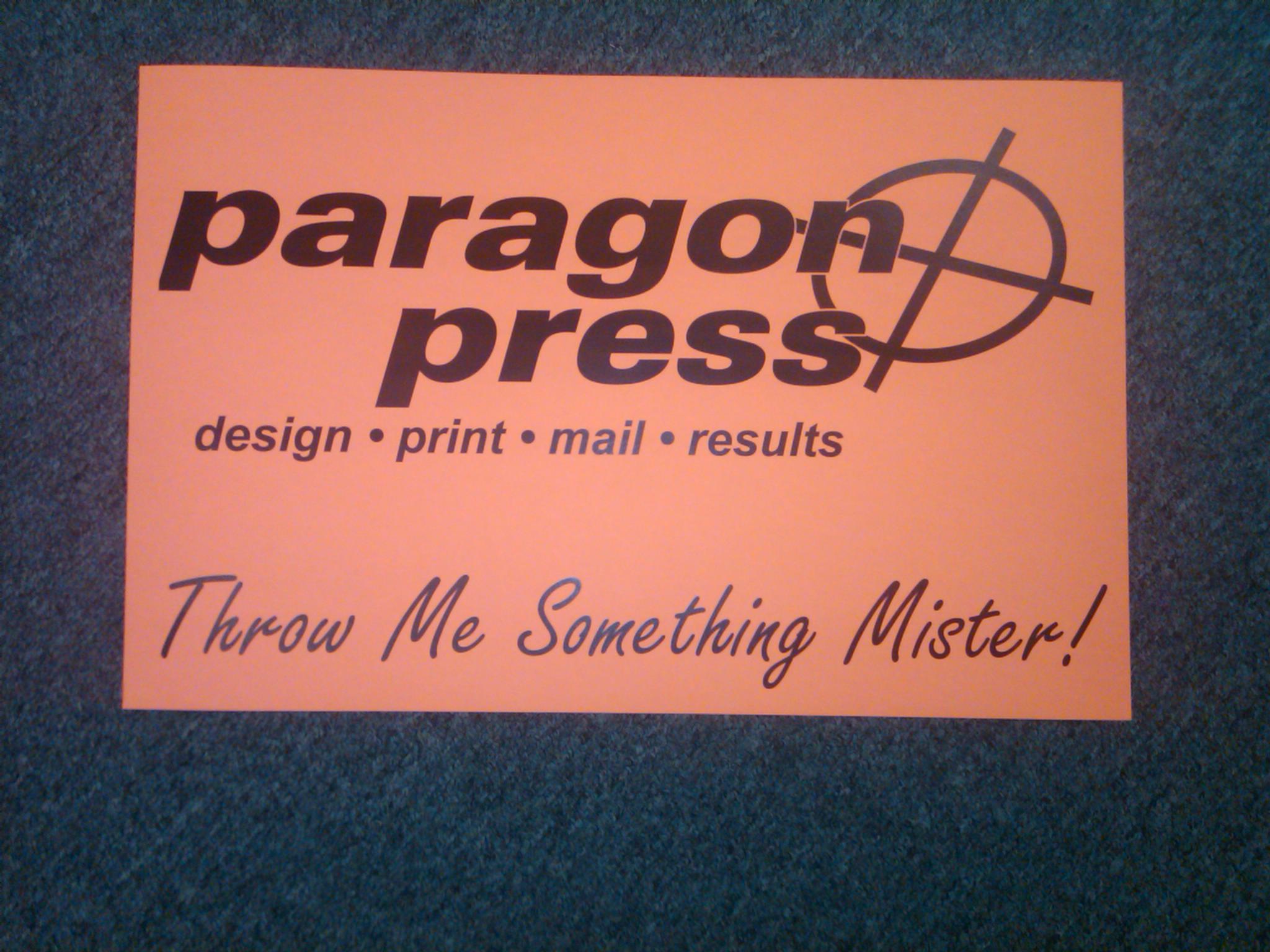
Sooooo, we created a simple sign (see below) with our name and logo on top and “Throw Me Something, Mister!” on the bottom. This is a popular phrase from the New Orleans parades where folks yell it to the floats to get them to throw the folks on the sidewalk beads, toys, cups, etc. We made our sign bright, neon orange.

We sent out emails to all our local friends and we posted it on Facebook and Twitter (“come get your free sign, hold it up to float #21 this Sat, and we’ll throw u something!), and they came.

We only printed 200 and we’re almost out!

The cool thing about this exercise was that sometimes the old formula works – all you have to do is advertise and promote.

Now granted, these signs were free, but it was still a cool thing to put “out there” to current and prospective clients…just trying to be the printer in Shreveport that takes things to the next level!

http://www.ParagonPress.ne